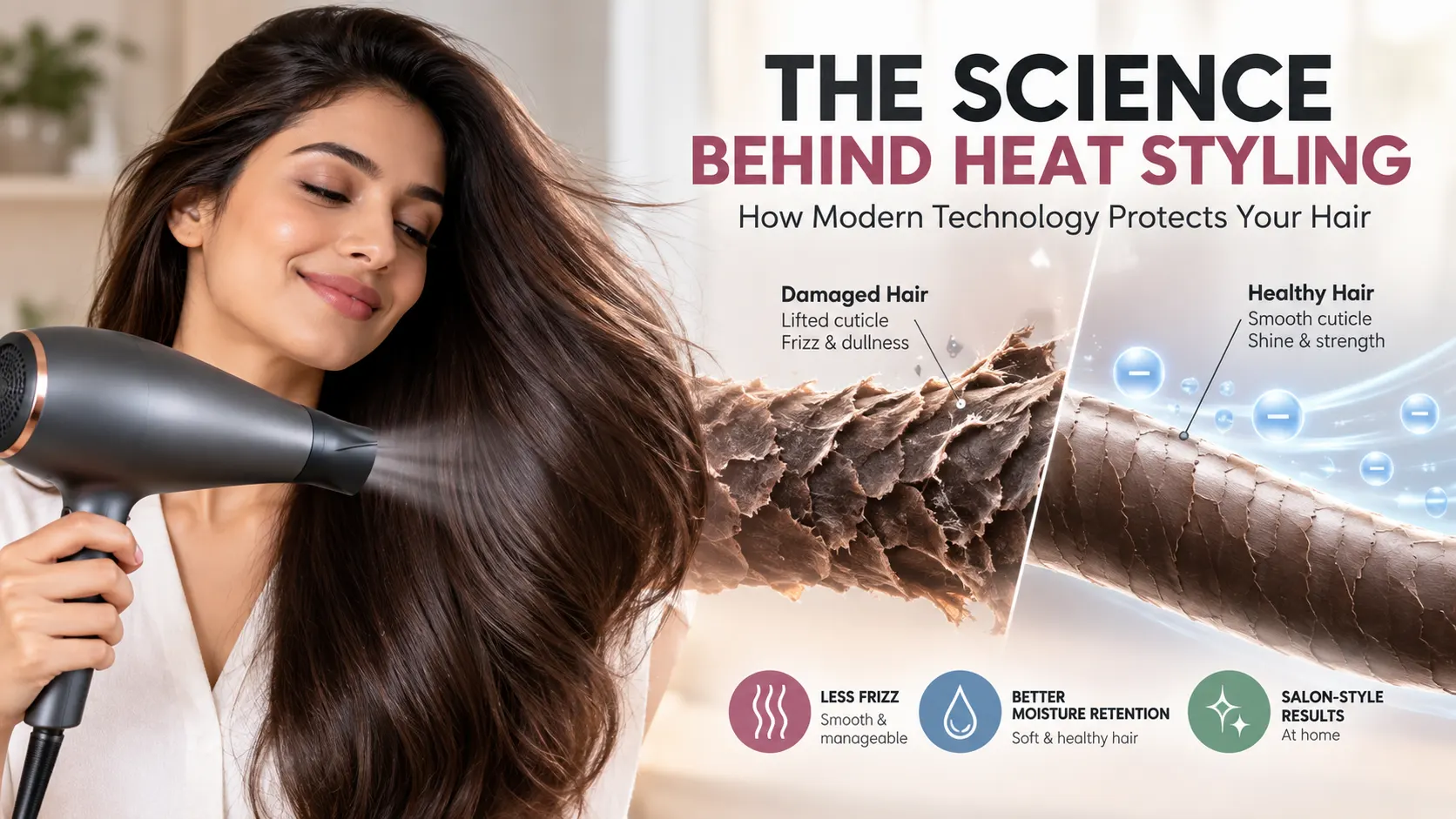
Heat styling is often viewed as a purely aesthetic ritual: you apply warmth to hair, and through some cosmetic alchemy, unruly curls transform into gleaming ribbons or damp waves dry into an airy, voluminous crown. But peel back the surface, and heat styling is in fact a sophisticated exercise in biophysics and polymer chemistry.
Every time you engage a blow dryer, straightener, or curling iron, you are manipulating the molecular architecture of human hair fibers. Done carelessly with substandard appliances, high temperatures can rupture the hair's protective cuticle shingles, vaporize vital intercellular moisture, and degrade structural proteins into brittle rubble. However, armed with state-of-the-art thermal engineering—such as Negative Ion Generation and proprietary Tress Care Technology™ developed by Beautians (backed by VIRANI TECHNOLOGIES)—you can achieve breathtaking, salon-grade styles while safeguarding the cellular integrity of every single strand.
In this scientific exploration, we unpack the microscopic anatomy of hair, explain the physics of ionic moisture retention, and reveal why intelligent heat distribution is the single most vital factor in preventing thermal damage.
Hair Anatomy 101: Cuticle, Cortex, and Chemical Bonds
To understand how thermal tools interact with hair, we must examine the three concentric layers of the human hair fiber:
- The Cuticle: The outermost defensive armor, composed of 6 to 10 overlapping shingle-like scales made of hard, sulfur-rich keratin. When healthy, these scales lie flat and tight, reflecting light to produce brilliant shine and locking moisture inside the core.
- The Cortex: Making up approximately 85% to 90% of the fiber's mass, the cortex houses parallel bundles of alpha-keratin polypeptide chains coiled like microscopic springs. It dictates hair's strength, elasticity, pigmentation (melanin), and natural curl pattern.
- The Medulla: The innermost canal of soft, sponge-like cells, present predominantly in coarse or thick hair types.
Within the cortex, keratin molecules are held together by three primary categories of chemical bonds:
- Disulfide Bonds: Permanent covalent bonds formed between sulfur atoms in cystine amino acids. These can only be broken by harsh chemical treatments (such as chemical relaxers or permanent waving solutions). Heat styling does not permanently alter disulfide bonds.
- Salt Bonds: Ionic attractions between acidic and basic amino acid side chains, vulnerable to shifts in pH.
- Hydrogen Bonds: Weak, electropositive linkages between hydrogen and neighboring oxygen or nitrogen atoms. Although individually weak, billions of hydrogen bonds collectively stabilize your hair's shape.
Heat and water possess the ability to temporarily break these hydrogen bonds. When you wash your hair or apply heat, the hydrogen lattice softens into an amorphous state (known in physics as the glass transition). As the hair cools or dries in a new geometric position—held straight between plates or curved around a round brush—the hydrogen bonds reform, cementing your chosen hairstyle until moisture or humidity disrupts the lattice again.
The Physics of Frizz: Static Electricity and Cationic Buildup
Why does hair succumb to uncontrollable frizz, flyaways, and dullness? The answer lies in electrical charge. Hair is inherently naturally negative-to-neutral in its resting state, but environmental friction—towel rubbing, plastic combs, synthetic clothing, and standard hot air currents—strips electrons from the hair shaft via the triboelectric effect. This leaves the outer cuticle layer loaded with positive (cationic) static charges.
Basic electromagnetism dictates that like charges repel. Because adjacent strands now share identical positive electrostatic charges, they physically push away from one another, resulting in the chaotic, untamable cloud we identify as frizz. Furthermore, positive static forces the delicate cuticle shingles to lift and flare outward like an opened pinecone. This lifted state scatters incoming light rather than reflecting it, robbing hair of its gloss and creating a porous highway through which ambient humidity rushes in, swelling the cortex and ruining your blowout.
How Negative Ion Technology Rescues Your Hair
Enter Negative Ion Generation, an engineering breakthrough integrated into the flagship Beautians AirBelle Professional Hair Dryer and the ultra-high-velocity Airsculpt Airfinite 2400W Hair Dryer.
These advanced tools house an internal ionizing transducer that fires a torrent of millions of negatively charged ions into the airflow. This delivers two monumental scientific benefits:
1. Immediate Electrostatic Neutralization
The flood of negative ions collides with the positively charged cuticle scales, instantly neutralizing the net electrostatic charge. With static eradicated, the cuticle shingles collapse flat against the hair cortex. The hair fibers instantly fall into parallel alignment, banishing flyaways, smoothing rough texture, and restoring mirror-like specular reflection (shine).
2. Micronization of Water Molecules
Conventional hair dryers blow blunt thermal air at large surface water droplets, requiring high heat and extended exposure times to evaporate moisture. In contrast, negative ions break large clusters of water molecules (H?O) into microscopic micro-droplets via ionic cleavage. These micro-droplets are so minute that a portion penetrates deep into the porous hair cortex, hydrating the core from within, while the remaining surface moisture evaporates in half the time. By drastically reducing total drying duration, your hair spends 50% less time under thermal duress.
The Thermal Threshold: Safe Temperatures vs. Keratin Denaturation
One of the most dangerous misconceptions in beauty is the belief that higher heat yields faster or longer-lasting styles. Modern trichology establishes precise biological boundaries for thermal exposure:
| Temperature Range | Biological Impact on Hair Fiber | Clinical Recommendation |
|---|---|---|
| Below 140°C (284°F) | Hydrogen bonds soften gently. Zero risk to keratin proteins. | Ideal for ultra-fine, bleached, or severely compromised hair. |
| 150°C – 185°C (302°F – 365°F) | The "Glass Transition Sweet Spot." Alpha-keratin softens flexibly without structural degradation. | Optimal setting for 90% of normal, healthy, or wavy hair types. |
| 190°C – 210°C (374°F – 410°F) | Required for dense, coarse, or resistant textures. Requires rapid, steady passes. | Use with caution; always apply professional thermal protectant. |
| Above 220°C (428°F) | Thermal Denaturation: The alpha-keratin helix irreversibly unravels into beta-keratin. Cuticle blistering occurs. | DANGER ZONE. Causes irreversible structural fragility and split ends. |
Why Tress Care Technology™ is a Revolutionary Shield
The greatest threat in conventional styling tools is not necessarily their target temperature, but rather thermal spikes and localized hot spots. In cheap heating elements, thermal coils fluctuate wildly: a straightener set to 180°C may surge to 235°C in the center of the plate while sitting at 140°C on the perimeter. That sudden 235°C surge burns through the cuticle in a split second, frying keratin proteins while leaving other sections under-styled.
To solve this epidemic of uneven heat, Beautians engineered Tress Care Technology™. Featured in precision tools like the Beautians Bangs Pro Straightener and the AirBelle Professional Dryer, Tress Care Technology™ continuously monitors heat flow across the ceramic surface hundreds of times per second. By maintaining uniform, micro-calibrated thermal equilibrium, heat transfers homogeneously into the hair fiber without dangerous thermal spikes. You achieve smooth, flawless realignment in a single glide, protecting the delicate keratin matrix from cumulative heat fatigue.
5 Widespread Heat Styling Myths Debunked by Science
Myth 1: "Sizzling steam coming off a flat iron means it's working faster."
The Truth: Sizzle is the acoustic signature of trauma. If your straightener produces audible hissing or heavy steam, water inside the hair cortex has reached boiling point (100°C), flashing into steam while trapped beneath the cuticle. This steam creates high internal pressure that expands and bursts the fiber, forming microscopic fractures known medically as trichorrhexis nodosa (bubble hair). Always ensure hair is 100% bone-dry before touching heated plates.
Myth 2: "Heat protectants make hair 100% fireproof."
The Truth: Thermal protectants are exceptional buffers—slowing down the rate of heat absorption and lubricating the cuticle—but they do not create an invulnerable force field. They mitigate up to 50%–70% of heat degradation. You must still pair protectants with calibrated tools and conservative temperature settings.
Myth 3: "Air-drying is always 100% healthier than blow-drying."
The Truth: Groundbreaking research published in the Annals of Dermatology revealed that prolonged air-drying allows the delicate cell membrane complex (CMC) of hair to stay swollen with water for hours. This chronic swelling exerts continuous pressure on the cuticle layer, a phenomenon known as hygral fatigue. The healthiest protocol is actually towel-blotting gently, applying heat protectant, and blow-drying on low-to-medium heat with an ionic dryer like the AirBelle, minimizing total time in a swollen wet state.
Myth 4: "Titanium is always superior to Ceramic."
The Truth: Neither material is universally superior; they serve distinct functions. Titanium heats almost instantaneously and conducts heat aggressively, making it perfect for thick, coarse, or resistant strands when wielded by experienced hands (as in the Sleekron FX). Ceramic, on the other hand, distributes heat gently and evenly with far infrared rays, making it the gold standard for normal, fine, colored, or sensitized hair (as in the Sleekron Bluebird).
Myth 5: "Cool shot buttons on hair dryers are just a marketing gimmick."
The Truth: The cool shot is scientifically indispensable. Warm air softens hydrogen bonds to reshape hair; cool air rapidly quenches the fiber, locking reformed hydrogen bonds into place and sealing the cuticle down tight. Finishing each section with a 10-second blast of cool air is the single most effective way to guarantee all-day style retention.
The Takeaway: Smarter Tools, Stronger Hair
Understanding hair science fundamentally transforms how you care for your tresses. Thermal styling does not have to be an ongoing compromise between temporary beauty and long-term damage. By selecting tools powered by Tress Care Technology™, harnessing the smoothing physics of Negative Ions, and respecting your hair's biological thermal thresholds, you can enjoy radiant, runway-caliber hair every day while keeping your keratin bonds stronger, healthier, and more resilient than ever before.