Plan around the week you actually have
A festive week can include work, family visits, shopping, travel, and more than one celebration. Trying to create a completely different hairstyle for every occasion can make preparation feel longer than the events themselves. Start by listing the days when you genuinely want a more finished look and the days when an easy arrangement is enough. Consider your outfits, departure times, and whether anybody else needs the same mirror or tools. The useful goal is a sequence you can repeat calmly, with room for changes when plans move.
Choose one base and two variations
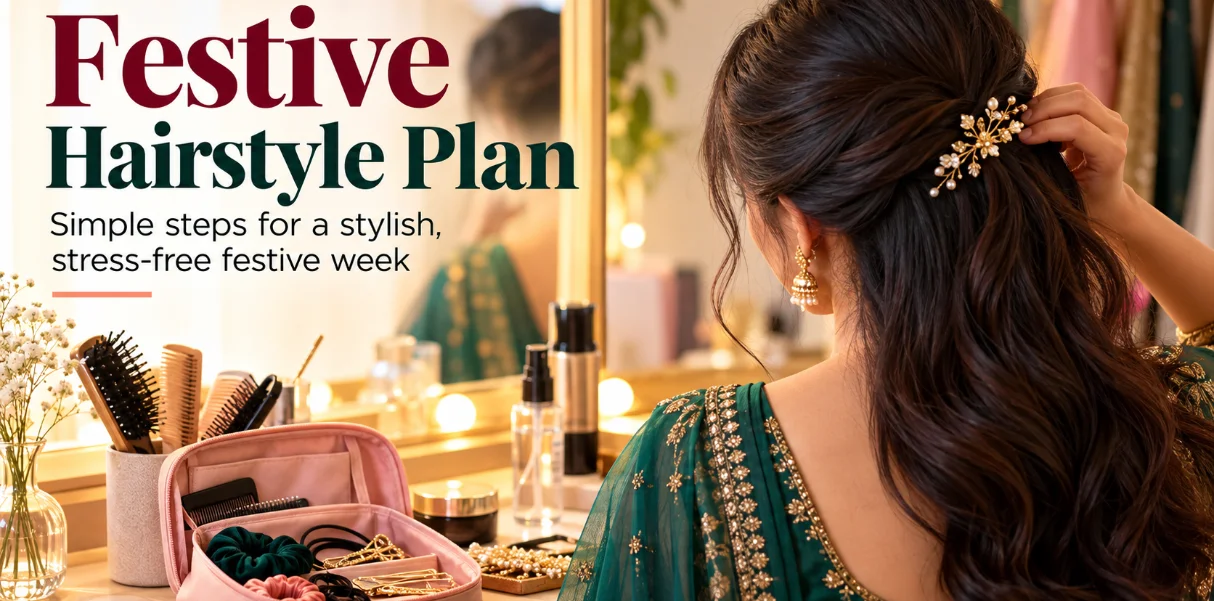
Select a base that suits your current length and texture: softly arranged waves, a smooth parting with natural movement, or a comfortable loose braid. Build two variations from it using a clip, a different parting, or a small front section. This gives each event its own character without requiring a complete restart. Lay out the accessories with the outfits so you can compare colours and placement. Avoid a complicated back section unless you can finish it independently. A style that depends on help is worth scheduling for a day when that help is available.
Schedule preparation before the busiest window
Think about how long your hair takes to wash and dry rather than assuming preparation can fit into any spare hour. Place the most involved session before a day when you have enough time to finish it properly. If you are going directly from work to an event, decide in advance which parts can be refreshed at the destination. Pack those accessories separately from your clothes. Keep the plan flexible if your scalp needs washing earlier than expected; an uncomfortable scalp is not a useful foundation for preserving yesterday's styling.
Match the hair to the outfit details
A high neckline, statement earrings, or a scarf can change which arrangement feels practical. Try the full outfit while checking the hair from the sides and back. Make sure a clip does not press against a collar and that loose lengths do not constantly catch on jewellery. If your event involves dancing or helping with food, choose a way to move the hair comfortably out of your face. These small checks prevent repeated adjustments later. They also show whether a simpler arrangement would allow the outfit's details to stand out more clearly.
Prepare a compact event pouch
An event pouch does not need every product from your dressing table. Add the clip or tie needed for your fallback, a few smooth pins if you use them, and a small comb suitable for your hair. Include only a finishing product you already know and can use according to its label. Keep liquids securely closed and separate from jewellery. If someone else will help with the back of the style, explain the intended arrangement before the last minute. A short description and one reference photograph usually communicate more clearly than several competing inspiration pictures.
End the evening with tomorrow in mind
After the celebration, remove accessories carefully instead of pulling them through the lengths. Count decorative pins as you take them out, especially when the style has several layers. Decide whether the hair needs washing, gentle detangling, or simply a loose arrangement for the night. Put reusable accessories where they can be cleaned or stored. Review which part of the look stayed comfortable and which needed constant attention. That information can simplify the next event. A good festive routine makes room for enjoyment while keeping the preparation and recovery manageable.
Try the change before an important day
A quiet practice session tells you more than a rushed attempt before leaving home. Use the same mirror, tools, and preparation that you expect to use later. Time the entire process, including drying, sectioning, cooling, and putting things away. Photograph the finished result in ordinary room light and again after your usual journey. Write down the steps that mattered and the steps that made little difference. Change one detail at the next attempt so you can identify what helped. A successful trial should leave enough time for breakfast, getting dressed, and a calm departure, rather than consuming every spare minute.
Keep product amounts easy to judge
Using several products at once makes it difficult to identify what actually improves your result. Choose each product for a clear task, such as providing hold or helping you manage the lengths. Follow the stated application method and begin with a small amount that you can distribute evenly. Allow the first application to settle before deciding whether to add more. If the finish feels stiff, greasy, or unexpectedly heavy, record the amount and reduce it next time. A simple routine is easier to repeat because the variables are visible. Labels, measuring pumps, and a short note in your phone are more useful than guessing from memory.
Make each heat session deliberate
Before using a heated tool, read its instructions and choose a setting that suits your hair and the task. Start conservatively rather than turning the dial straight to maximum. Keep straighteners and curling irons for fully dry hair unless the manufacturer explicitly specifies another method. A heat protectant is an additional precaution, not permission to make unlimited passes. Section first, work steadily, and stop when the result is acceptable. If a strand needs repeated correction, reconsider its size, preparation, or starting texture instead of immediately adding more heat. Days without heated styling can still include a tidy parting, a loose braid, or a comfortable clip.
Choose accessories by comfort and fit
A clip or tie should support your hairstyle without making the scalp feel pulled. Check the edges, hinges, and fastening before placing it in the hair. Smooth surfaces are easier to remove than damaged parts that catch individual strands. Match the accessory to the amount of hair it must hold rather than choosing by appearance alone. If it slips, change its position or choose a better size instead of fastening it with extra tension. Carry one simple alternative when you will be away from home for several hours. The most useful accessory is the one you can insert, wear, and remove comfortably without help.
Account for the journey as well as the mirror
Think about what happens between your dressing table and your destination. A walk outside, a crowded journey, a helmet, or an air conditioned office can each change how a style sits. Take a photograph after your normal trip so you can identify the areas that move or flatten. Arrange accessories in positions that remain comfortable during the journey, and follow transport safety requirements. Pack a compact comb and one useful clip rather than a full styling kit. At the destination, give the hair a moment to settle before refreshing it. A practical hairstyle should work during the journey as well as immediately after preparation.
Have a calm fallback ready
Choose a second hairstyle that you can complete with the hair in its current condition. For longer lengths, that could be a loose braid or a comfortable clipped arrangement. For shorter lengths, it might be a different parting or a simple tucked section. Practise removing the first style and making the second without aggressive brushing or extra tension. Carry only the accessory needed for that change. Knowing you have a workable fallback makes it easier to stop correcting a style that is not cooperating. It also helps when a journey, an unexpected shower, or a longer than planned day changes your original arrangement.
Plan the transition to the next morning
Remove clips, pins, and firm accessories before bed, and check that none are hidden beneath the hair. Choose a loose arrangement that feels comfortable while you turn your head on the pillow. Do not tighten a tie simply to keep every strand in place overnight. If your preferred pillowcase or wrap reduces snagging for you, include it in the routine, but keep expectations realistic. The next morning, allow the hair to fall naturally before deciding what needs adjusting. Sometimes a flattened section changes shape after a few minutes. A small amount of patience can prevent unnecessary brushing and another round of styling.